0171-4081962
98962-77713
0171-4081962
98962-77713
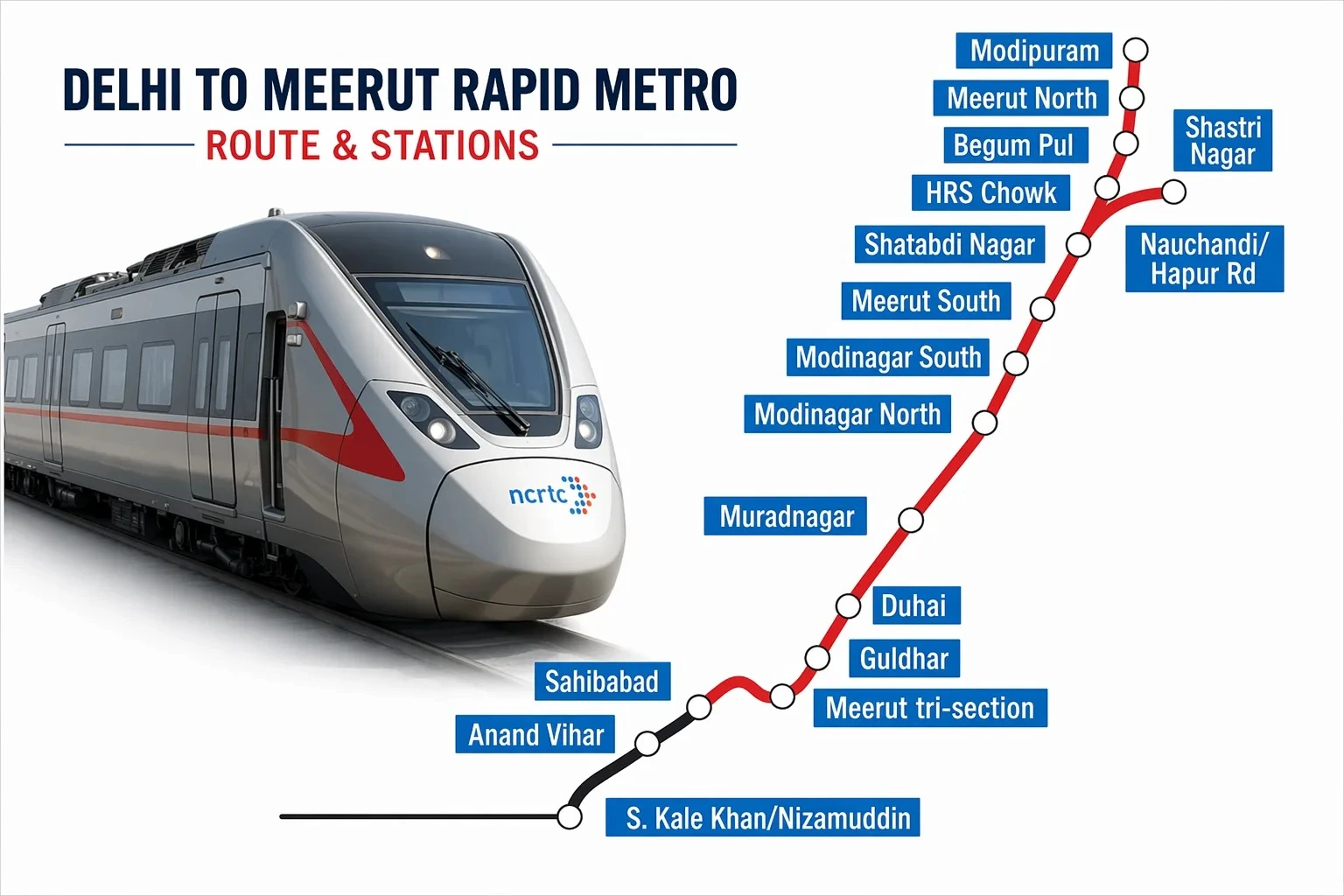
Travelling between Delhi and Meerut has always been a test of patience. Long road jams, crowded trains, and unpredictable delays made every trip exhausting. That changes now. The Namo Bharat train, officially known as the Delhi-Meerut Regional Rapid Transit System (RRTS), is redefining what it means to commute across the National Capital Region. Whether you're a daily office-goer, a student, or a weekend traveller, here's everything you need to know before you board.
Namo Bharat (RRTS) is India's first high-speed regional rail corridor, designed to cut travel time between Delhi and Meerut from over two hours on roads to just around 55 minutes. Unlike regular metro, it runs at higher speeds of up to 180 km/h and covers longer distances, connecting cities rather than just neighbourhoods. Alongside RRTS, the Meerut Metro (MRTS) is being developed to serve within Meerut city limits, creating a seamless two-tier transit experience.
The Delhi-Meerut Regional Rapid Transit System (RRTS) spans approximately 82 kilometres, cutting through some of the most densely populated and economically active zones of NCR. The corridor links Delhi, Ghaziabad, and Meerut, three cities that form the backbone of western UP's urban growth.
Here are the major stops you'll encounter travelling from Delhi to Meerut.
Sarai Kale Khan is the Delhi entry point, offering seamless interchange with Delhi Metro and intercity buses.
Anand Vihar is a major connectivity node, linking RRTS with the metro, interstate bus terminus, and railway station.
Sahibabad and Ghaziabad serve a large working population commuting daily into Delhi.
Duhai Depot serves as the maintenance hub for Namo Bharat trains.
Muradnagar and Modinagar connect smaller industrial and residential townships.
Meerut South and Shatabdi Nagar act as gateway stations into Meerut.
Begumpul and Modipuram cover the final stretch into central and northern Meerut.
The Namo Bharat (RRTS) has been scheduled to keep both early risers and late-nighters covered.
Operating hours run from 6:00 AM to 11:00 PM daily. During peak hours, trains arrive every 5 to 10 minutes, while off-peak frequency is every 10 to 15 minutes.
The total journey time from Delhi to Meerut is approximately 55 minutes end-to-end.
Two types of services run on the corridor:
• Express trains skip select stations for faster travel.
• Standard trains halt at every station.
Fares for the Delhi-Meerut Regional Rapid Transit System (RRTS) follow a distance-based model, making it affordable for daily commuters while keeping pricing transparent. Tickets are available through the official app, station kiosks, and smart cards. Using a RRTS smart card offers a small discount over single-journey tokens, making it a good choice for frequent travellers.
• Arrive at least 10 minutes early at busy stations like Anand Vihar and Sarai Kale Khan during peak hours.
• Use the official app or NCRTC portal to check real-time schedules before travelling.
• For intra-city travel in Meerut, switch to Meerut Metro (MRTS).
• Premium coaches are available on select trains for extra comfort.
The Namo Bharat corridor is more than just a train—it represents a transformation in how NCR travels. As more stations become operational and services expand, commuting between Delhi and Meerut will become faster, smarter, and more comfortable.

For a new experience download
RAJBHOG KHANA app now